Rosedil supplement facts: the panel as printed, line by line
The Rosedil Supplement Facts panel in the pack's label image gives a serving size of 2 capsules and 30 servings per container, then lists eight ingredients with an amount and a percent daily value. The panel on your bottle is the one that counts, so compare it with this page when the bottle arrives.1
A panel is the one part of a supplement label that follows a set format. That makes it the best place to check a product, because every line must give an amount, and every amount can be compared with a government figure.
The panel as the label prints it
| Ingredient | Amount | Daily value |
|---|---|---|
| Vitamin C (as ascorbic acid) | 157 mg | 174% |
| Vitamin B3 (as niacin) | 30 mg | 188% |
| Vitamin B6 (as pyridoxine hydrochloride) | 1.6 mg | 94% |
| Biotin | 4,620 mcg | 15,400% |
| Vitamin B5 (as d-calcium pantothenate) | 14 mg | 280% |
| Calcium (as dicalcium phosphate) | 11 mg | 1% |
| Zinc (as zinc oxide) | 12 mg | 109% |
| Horsetail (Equisetum arvense) extract | 25 mg | Not established |
The daily values come from the label and use the FDA's reference amounts. A percentage above 100 does not mean harm by itself, and the NIH upper limits, not the daily value, are the numbers that mark a ceiling. The next section shows which lines are near a ceiling and which are not.
The label image
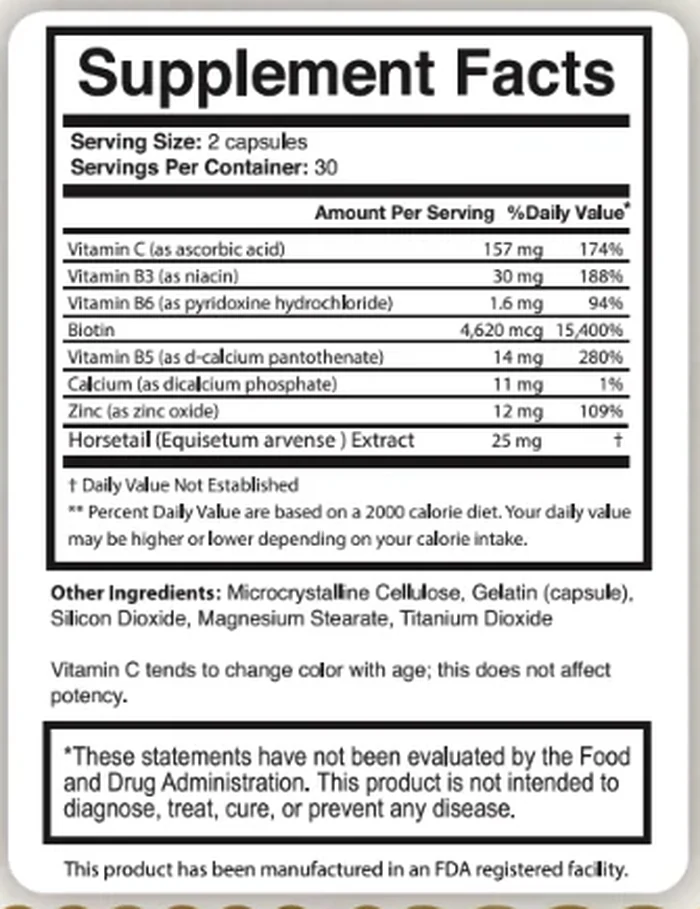
The image is a scan of the label as supplied in the pack. It is small, so we typed the figures into the table above and checked them against the image twice. If your bottle differs, trust the bottle.
How to read the percent daily values
The daily value is a label reference for one nutrient, and it is not a recommendation for you. Biotin at 15,400% sounds alarming, and it simply means the amount is 154 times the label's reference of 30 mcg.2 Calcium at 1% means the capsule holds a negligible amount. Horsetail has a dagger because no daily value is established for it.
| Line | What the percentage tells you |
|---|---|
| Biotin 15,400% | The amount is 154 times the reference |
| Vitamin B5 280% | A little under three times the reference |
| Vitamin C 174% | About one and three-quarter times the reference |
| Vitamin B3 188% | Close to twice the reference |
| Zinc 109% | Just above the reference |
Other ingredients and the vitamin C note
The panel lists microcrystalline cellulose, gelatin (capsule), silicon dioxide, magnesium stearate and titanium dioxide as other ingredients. A note under the panel says vitamin C tends to change color with age and that this does not affect potency, which is the maker's statement and one we cannot test.
Below the panel the label prints the FDA statement, which says the statements have not been evaluated by the Food and Drug Administration, and a line that the product was "manufactured in an FDA registered facility". We show that wording as printed and mark it unverified. A facility registration is a filing, and it is not an approval of the product.3
What to do with the panel
Take a photograph of your bottle's panel and keep it with your order email. If you take any prescription, show the photograph to your pharmacist, and mention the biotin line first, because it affects lab tests. Our ingredients page puts the amounts next to NIH figures, and the biotin and lab tests page covers the test issue.
If you want to see how the panel fits with the rest of the label, see the label claims page.
- Serving size: 2 capsules, so one day on the label.
- Servings per container: 30, so 60 capsules.
- Eight named ingredients, each with an amount in mg or mcg.
- Five other ingredients, including gelatin for the capsule.
Count each of these on your own bottle. If you take other supplements, compare their panels with this one, since the totals matter more than any single line. The safety page and the medications page explain what to ask.
Panels follow a fixed format because the FDA's labeling rules require the serving size, the servings per container and each ingredient with its amount. That is why two products can be compared line by line, and why a product with a missing or vague panel is harder to judge.1 If you ever see a panel that lists a blend with no amounts for each part, ask the seller for the breakdown.
Frequently asked questions
How many servings are in a Rosedil bottle?
Thirty, with two capsules in each serving, so the bottle holds 60 capsules.
What does the dagger on the horsetail line mean?
The label says the daily value is not established for horsetail extract, so no percentage is printed.
Does the panel list the form of each vitamin?
Mostly. It names ascorbic acid, niacin, pyridoxine hydrochloride, d-calcium pantothenate, dicalcium phosphate and zinc oxide.
Where can I see the label myself?
In the label image on this page, and on the bottle when it arrives.